Zurich, 14 November 2026
Since its opening alongside the World Economic Forum in January 2024, the AI House Davos has become a central meeting point for the global conversation on artificial intelligence. A joint initiative of Merantix and the ETH AI Center together with Swisscom and further partners, it brings together researchers, industry, governments and civil society on neutral ground on the Davos Promenade. ICT4Peace, a long-standing interlocutor of the ETH AI Center, has been invited to the AI House in two consecutive years.

The AI House at Promenade 67, Davos (photo: Daniel Stauffacher) |
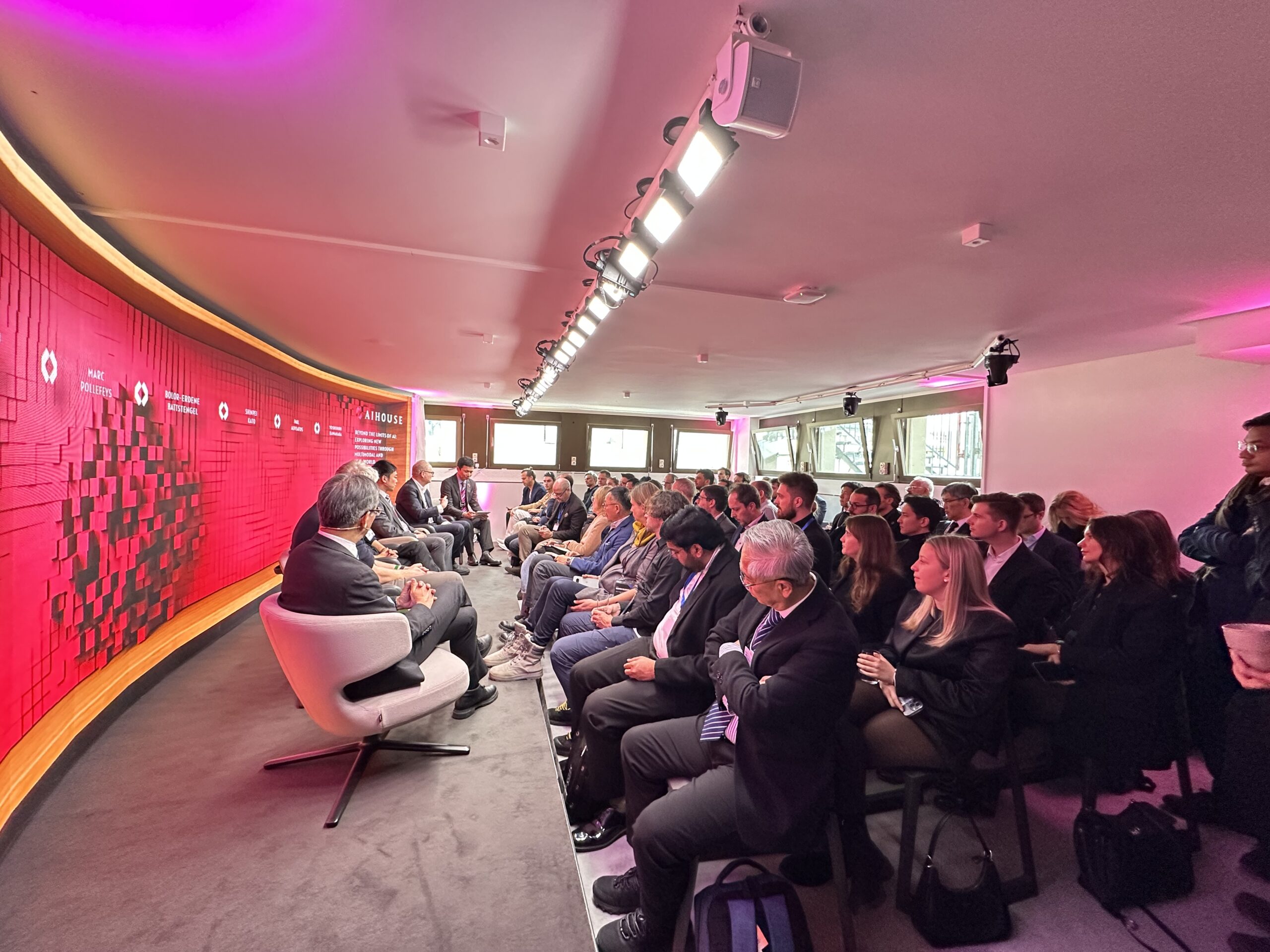
Panel at the AI House Davos (photo: Daniel Stauffacher) |
January 2025. Daniel Stauffacher, Founder of ICT4Peace, attended sessions including “Dual Use – AI in Conflict”, “Can We Resolve the Paradox of Sustainable AI?” and “After the Hype: Visions of Tomorrow Through AI Art”, and exchanged with the AI House team on the role of academia as a catalyst for large-scale AI.
January 2026. ICT4Peace was again invited to the AI House Davos (19–23 January 2026) under the theme “A Human Intelligence Shift”. Daniel Stauffacher followed a programme that included “Large Scale AI as a Public Infrastructure”, “A Matter of Life and Death: AI in Military Decision-Making”, “Sustainable AI: From Climate Science to Efficient Computing”, “AI We Can Trust: Collective Systems for Global Safety” and “Open-Source AI: Advancing a Human-Centered Intelligence Frontier”. From the floor of the panel on large-scale AI as public infrastructure – moderated by Sunnie Groeneveld with Prof. Andreas Krause (ETH AI Center), Petri Myllymäki, Audrey Herblin-Stoop (Mistral AI) and Peter Sarlin – he raised the nexus between AI, critical minerals and the just energy transition.
A proposal for 2027. Following the 2026 edition, ICT4Peace wrote to the AI House curators at Merantix, the ETH AI Center and Swisscom proposing a panel on this nexus. Digital technologies are powerful enablers of climate action, from AI-driven early-warning systems to smart grids, but digitalisation is not immaterial: it relies on energy-intensive infrastructure and on critical transition minerals such as lithium, cobalt, copper, nickel and rare earths, for which the clean-energy transition is itself driving surging demand. The risks – supply bottlenecks, price volatility, geopolitical tension and harm to vulnerable and indigenous communities – are now recognised at the multilateral level: UN General Assembly Resolution A/RES/79/277 on the WSIS+20 Review, adopted by consensus in December 2025, addresses the environmental footprint of digital technologies (paras. 42–47) and, in paragraph 44, the need for the sustainable and responsible use of the critical mineral resources underpinning digital infrastructure. The ETH AI Center welcomed the proposal as “an important and timely topic” to be considered for the next edition. ICT4Peace set out this nexus in Daniel Stauffacher’s commentary on the WSIS+20 Review at the UN in New York: Digital Transformation, Critical Minerals & Just Energy Transition (28 December 2025) and in the ICT4Peace policy paper “Digital Transformation, Critical Minerals, and Just Energy Transition” (February 2026), which argues that digitalisation can enable a just energy transition only if responsible mineral sourcing, life-cycle sustainability and policy coherence across the digital, climate, energy and development agendas are built in from the start. ICT4Peace has accepted the invitation to the AI House Davos 2027 (18–22 January 2027).
A second proposal for 2027: extreme AI risks. ICT4Peace is also proposing that the AI House Davos 2027 take up the governance of extreme AI risks. In July 2026 ICT4Peace published the policy paper “Sovereignty, Access, and Extreme Risks: A Three-Layer Architecture for International AI Governance”, which proposes a narrow binding core for extreme, inherently transboundary risks – loss of human control over the most advanced systems and their misuse for biological, cyber or military harm – coupled with guaranteed access and national sovereignty over everything else. On 6 July 2026 ICT4Peace, the Strategic Foresight Group, the IFRC and GCSP launched the Global Compact on Extreme AI Risks in Geneva, and on 2 October 2026 the Swiss Parliament backed minimum standards on extreme AI risks for the Geneva AI Summit 2027. ICT4Peace is preparing, with GCSP and the Strategic Foresight Group, an expert workshop on extreme AI risks in Geneva in late January 2027, immediately after the World Economic Forum, as an input to the Summit. A session at the AI House, with the ETH AI Center at its core, would connect the Davos conversation on frontier AI directly with the Geneva process.
See also ICT4Peace’s work on digital sovereignty and extreme AI risks and its contributions to the Geneva 2027 AI Summit.