
Short Analysis of the)COP30 Results Regarding Minerals (Just Transition Work Programme Minerals
COP30 concluded on 22 November 2025 in Belém with a mix of progress and unresolved challenges—once again illustrating the inherent difficulty of achieving global consensus, especially when countries are deeply divided on how far and how fast to move forward.
This dynamics was particularly evident in the negotiations on mineral policy within the Just Transition Work Programme (JTWP). Despite the strong commitment of many parties, China—supported by Russia—made the inclusion of any language on the topic of minerals a “red line,” ultimately preventing its adoption. This occurred even though several countries and major negotiating blocs had proposed constructive text and advocated strongly for it.
At the beginning of the process, the UK and the EU submitted a robust text supported by the African Group of Negotiators, AOSIS (Alliance of Small Island States), the Environmental Integrity Group, Switzerland, Mexico, South Korea, Liechtenstein, Australia, Botswana, Burkina Faso, Colombia, Ethiopia, Panama, Peru, Somalia, South Africa, Uganda, and Uruguay.
The Presidency’s text then read as follows:
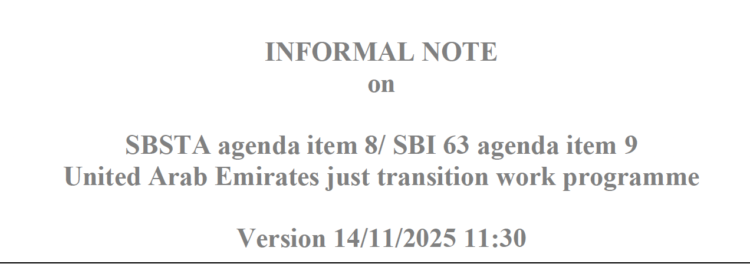

As mentioned, it was rejected by China and Russia and was subsequently removed.
A Breakthrough for Rights and Justice
Nevertheless, the Just Transition Work Programme became one the more significant achievements of COP30 — for workers, communities, indigenous peoples and other vulnerable groups worldwide. It demonstrates that more ambitious climate goals can be possible when social justice is at the center.
See the final JTWP text on this:
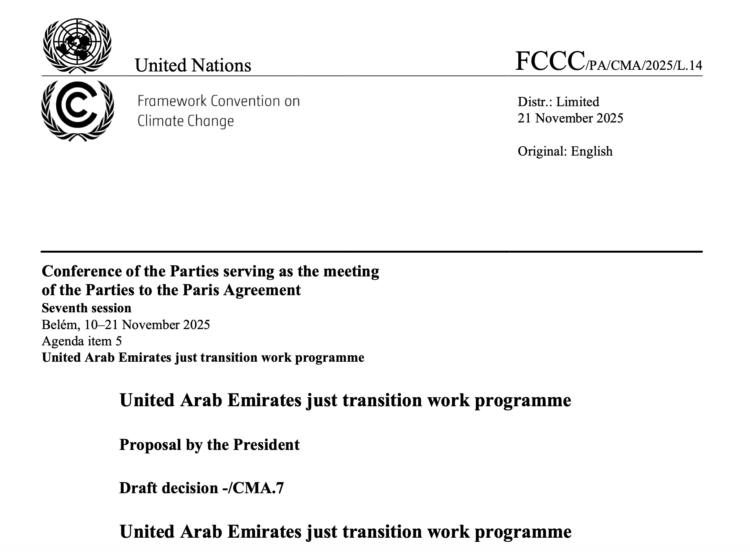
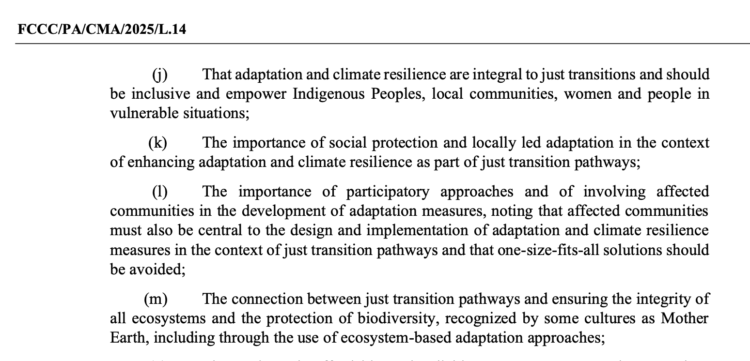
No previous COP decision has ever contained such ambitious and comprehensive language on rights and inclusion: human rights, labor rights, the rights of Indigenous peoples and people of African descent, as well as clear references to gender equality, the empowerment of women, education, youth development, and much more.
This outcome did not happen by chance. It is the direct result of years of joint efforts by trade unions, communities, NGOs, social movements, Indigenous peoples’ organizations, and civil society at large—efforts that were significantly intensified this year to achieve a result at COP30.
Looking ahead, the Just Transition Work Programme provides a solid foundation to build upon. We now know the extent of support for minerals governance and have a clearer idea of where to focus our efforts in the coming year.
Even though minerals were ultimately not included in the final text, this is not the end of the story. Importantly, nothing in the Just Transition decision excludes the minerals sector or limits the scope of the programme. One could even argue that we now have a mechanism that covers all dimensions of the transition—including minerals. If it is well-developed in the coming year, it could become a useful tool.
Success is not measured solely by the words that made it into the final text. Raising the issue, securing broad support, and firmly anchoring minerals governance in climate policy are significant achievements with real potential for long-term impact.