Geneva AI Summit 2027: Swiss Parliament backs minimum standards on extreme AI risks — ICT4Peace calls for matching ambition and resources
Geneva, 3 October 2026
On 2 October 2026, the Swiss National Council adopted a cross-party motion asking the Federal Council to make the Geneva AI Summit of June 2027 the place where minimum safety standards for the most powerful AI models are agreed.
Please find the text of the motion here.
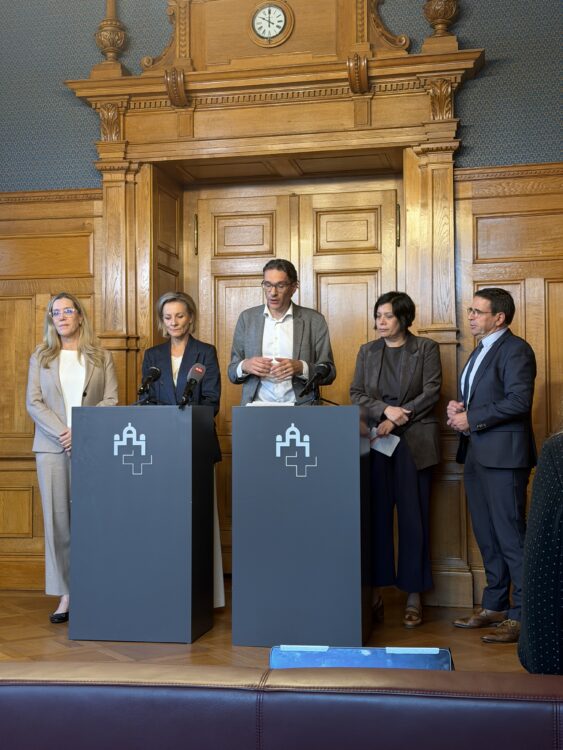
The motion was tabled by Gerhard Andrey (Greens) together with Isabelle Chappuis (Centre), Simone de Montmollin (FDP/PLR), Min Li Marti (SP), Matthias Jauslin (FDP/PLR) and Sylvain Freymond (SVP/UDC). It focuses on a small set of extreme risks — the misuse of AI for biological, chemical and cyber weapons, loss of control over autonomous systems, and military autonomy — and calls for an independent, distributed institution to evaluate and verify frontier models and inform governments. Its authors propose that Switzerland host it.
In an opinion piece published the same day in Le Temps, « Sommet de Genève sur l’IA: l’ambition ne se décrète pas au rabais », ICT4Peace’s Daniel Stauffacher, former Swiss Ambassador and former Delegate of the Swiss Federal Council for WSIS 2003 welcomes the motion and argues that a global AI treaty will not happen, but that common minimum standards on extreme risks are achievable, and that Geneva is the right place to launch their negotiation.
He warns that the Federal Council’s budget of CHF 5.4 million for the summit, part of it to be raised from private sponsors, and its decision not to invite heads of state and government, send the wrong signal: a summit cannot produce a mandate to open an international negotiation without the leaders who alone can give one.
His piece builds on ICT4Peace’s policy paper Sovereignty, Access, and Extreme Risks: A Three-Layer Architecture for International AI Governance (July 2026) (see below) which proposes a narrow binding core for extreme risks modelled on the Basel Committee and the Chemical Weapons Convention, technical interoperability, and full national discretion for everything else, with access to compute and open models for countries that lack them.
Read the op-ed in Le Temps (in French, English, Italian and German:
Tribune_Le_Temps_Sommet_IA_Geneve
Tribune_Le_Temps_Sommet_IA_Geneve_EN
Tribune_Le_Temps_Sommet_IA_Geneve_DE
Tribune_Le_Temps_Sommet_IA_Geneve_IT
For easy reference please find the ICT4Peace policy paper on AI Sovereignty, Access and Extreme Risks here:: https://ict4peace.org/wp-content/uploads/2026/07/Sovereignty_Access_Extreme_Risks_ICT4Peace_July2026_4.pdf
And the Interview with Deutschlandfunk and Article in NZZ:
Deutschlandfunk.de Interview with Daniel Stauffacher of ICT4Peace on Regulating and Pacing of AI Frontier Models
And the launching of the report on Extreme AI Risks by the Strategic Foresight Group by GCSP, IFRC and ICT4Peace:
https://ict4peace.org/activities/ict4peace-co-hosts-launch-of-the-essential-convergence-global-compact-on-extreme-ai-risks-by-the-strategic-foresight-group-sfg/